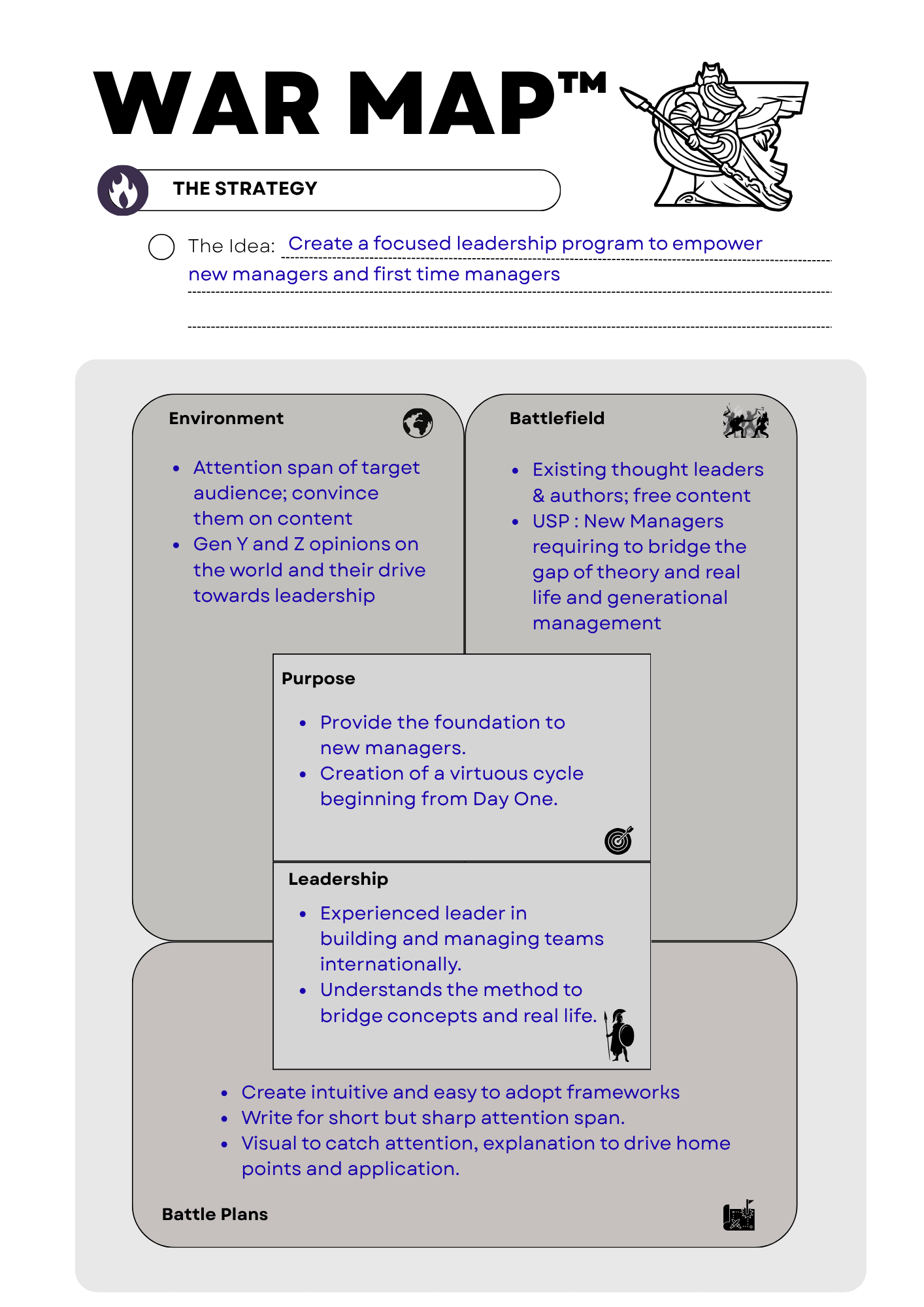
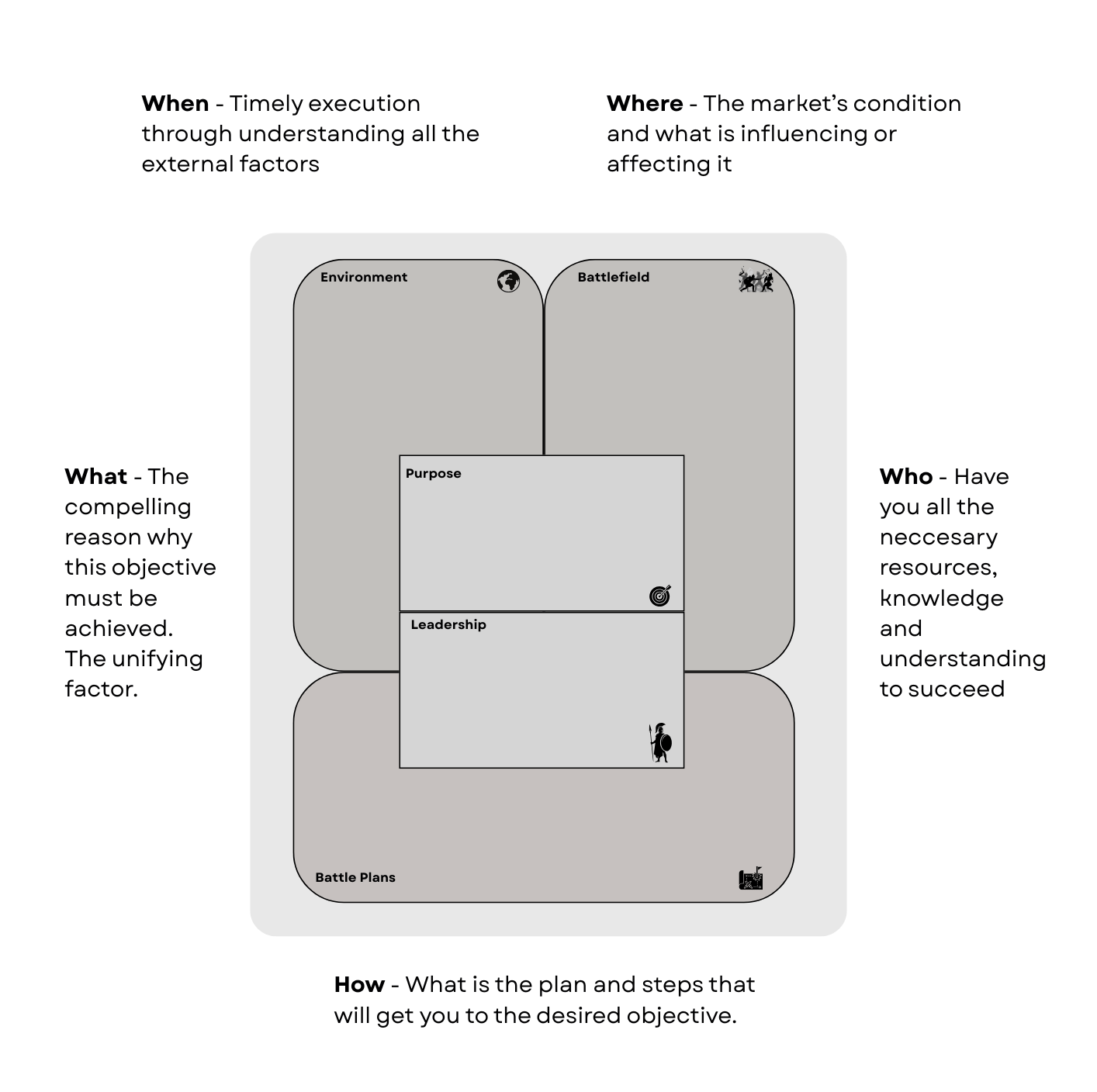
We’ve taken Sun Tzu’s five foundational elements and transformed them into a practical leadership canvas you can use to form, align, and stress-test your strategies. This isn’t just a worksheet; it’s your blueprint for success. Here are the five key factors to consider.
1. The Purpose (Sun Tzu: Moral Law)
This is the “Why.” It’s your unifying vision and mission. Before you begin, you must articulate a compelling purpose that inspires and unifies your team. A clear purpose ensures that every action serves a higher goal, giving your team the drive and morale to face any challenge. Without it, your people are simply a collection of individuals, not a cohesive force.
2. The Environment (Sun Tzu: Heaven)
This is the “When.” Sun Tzu taught that a commander must understand the seasons, the weather, and the cycles of the day. In business, this means understanding the macro-environment: market cycles, seasonality, technological shifts, and consumer demand. By analyzing these external forces, you can determine the optimal timing for your actions and move with the market, not against it.
3. The Battlefield (Sun Tzu: Earth)
This is the “Where.” The terrain determines where and how you engage. Here, you’ll map your competitive landscape, analyze market segments, and identify the contextual factors that will shape your strategy. This is where you assess the specific ground you’ll be fighting on—your unique position, your competitors’ strengths, and the opportunities for uncontested space.
4. The Leadership (Sun Tzu: Commander)
This is the “Who.” A plan is only as good as the person who executes it. This element is about assessing your own leadership capability—your ability to mobilize resources, make tough calls, and inspire confidence when the stakes are highest. It also includes the strength of your entire leadership team and their capacity to lead the charge.
5. The Battle Plan (Sun Tzu: Method & Discipline)
This is the “How.” A sound plan and disciplined execution turn a vision into a reality. This final element focuses on the practical details: the systems, processes, metrics, and disciplined actions that will ensure every effort contributes to the objective. It is the engine that drives your entire operation.
By answering these five fundamental questions, Why (The Purpose), When (The Environment), Where (The Battlefield), Who (The Leadership), and How (The Battle Plan) you are not just creating a plan. You are building something bigger. The ‘What’ is the strategy that encompasses all these five factors, turning your vision into a blueprint for tangible success.
The War Map™ Explained
Wisdom of Sun Tzu in the Art of War
1. If you know the enemy and know yourself, you need not fear the result of a hundred battles. If you know yourself but not the enemy, for every victory gained, you will also suffer a defeat. If you know neither the enemy nor yourself, you will succumb in every battle.
2. Five essentials for victory
He will win who knows when to fight and when not to fight.
He will win who knows how to handle both superior and inferior forces.
He will win whose army is animated by the same spirit throughout all its ranks.
He will win who has military capacity and is not interfered with by the sorvereign
The War Map™ Deployed
I built the program based on the strategic thinking shaped through the framework. It needs to cover all the perspective to build a strategy that is workable. The companion file is in the next chapter.