

Introduction: From 3Ts to 3Cs
In traditional management training, one of the earliest lessons passed down through the industrial-era master-apprentice model was the “3Ts”: Tell, Teach, Test. The idea was simple – tell someone what to do, show them how to do it, then test them to ensure they’ve got it. While this model had its place in command-based, compliance-driven environments, it no longer reflects the complex, collaborative nature of modern leadership.
In today’s world, people expect more than instructions. They want to be part of the conversation, co-creators of solutions, and contributors to progress. And that’s where the evolution begins.
In The Great Manager Program, I use two interlocking 3C frameworks that turn communication into clarity, action, and ownership.
The Actionable Communication Framework
The first 3C model is what I call your Communication Style:
Concise. Clear. Convinced & Convincing.
This is how you speak to your team. It means you:
Speak concisely: trim the fluff, focus on the essence.
Speak clearly: define the problem, the goal, and the ask.
Speak with conviction: believe in what you’re saying, and say it in a way that brings others along.
This 3C style shapes your leadership presence. It defines the voice of your leadership. But great communication doesn’t stop at delivery. It must translate into understanding, alignment, and action. That’s where the second framework comes in.
The 3Cs of Collaborative Execution
Once you’ve delivered your message, you move into Actionable Communication using the second 3C model:
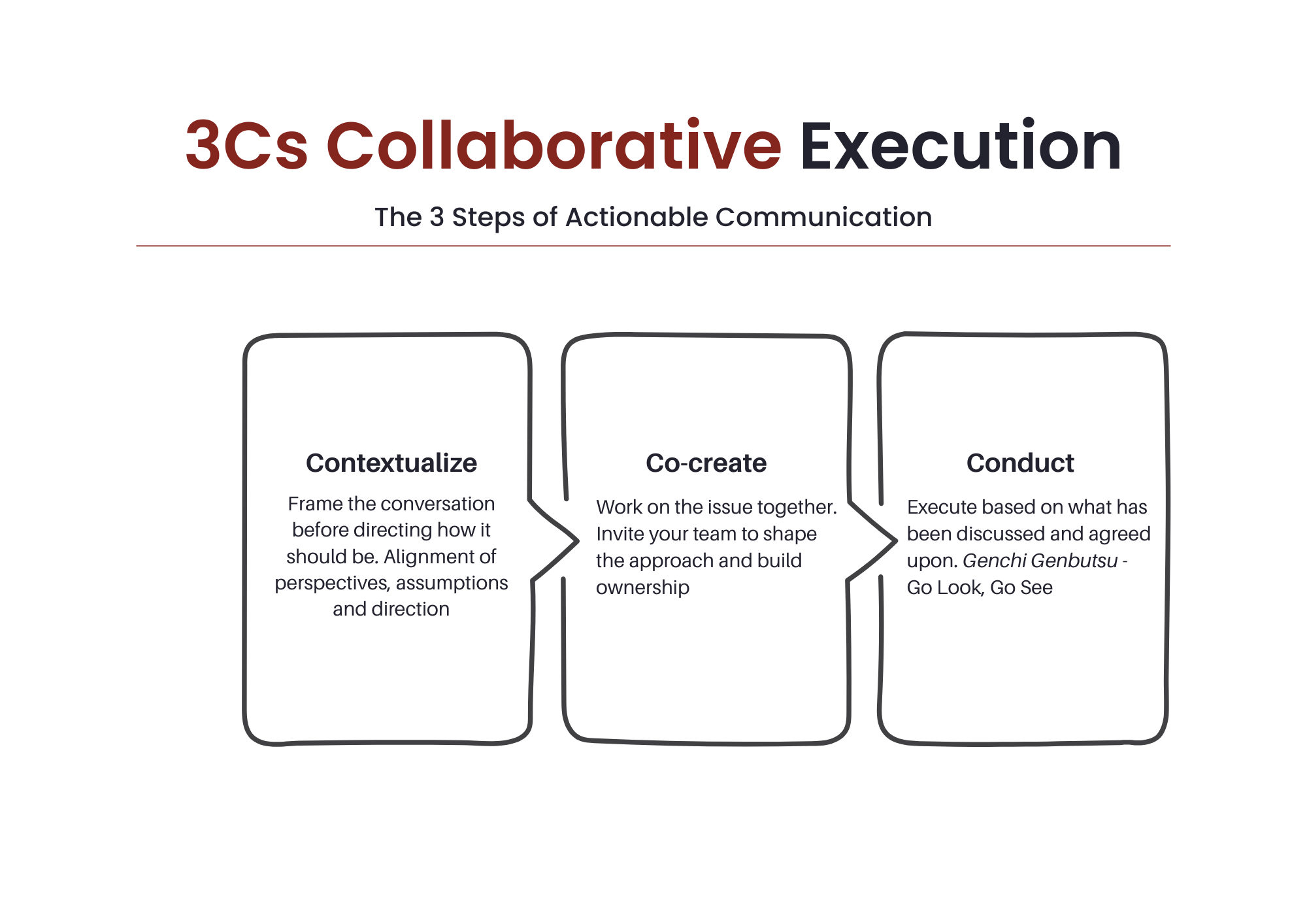
Contextualize. Co-Create. Conduct.
This is your method of turning communication into performance.
1. Contextualize
Frame the conversation before directing it.
Before giving instructions, help your team understand the big picture. Align their current mindset, experience, or assumptions with the team’s direction. Let them see how their role connects to the goal. This prevents misinterpretation and builds trust.
2. Co-Create
Solutions are stronger when created together.
Instead of handing down answers, invite your team to shape the approach. This builds ownership. People commit to what they co-create. You’ll surface better ideas and deepen team engagement.
3. Conduct
Move from idea to action, together.
This is where the rubber meets the road. Conduct pilots, support execution, offer feedback, and refine as you go. It’s inspired by the Japanese principle of Genchi Genbutsu – go and see it yourself. Leadership walks the floor, sees the plan in action, and offers real-time guidance.
Exercise: Your 3C in Action
Think of a recent or upcoming team situation. Work through both 3C models:
Step 1: Communication Style
What’s your core message? Can you express it concisely?
Is it clear? Would a team member repeat it the same way?
Are you personally convinced? Does your tone reflect that?
Step 2: Collaborative Execution
How will you contextualize this message for your team?
What part of the plan can you co-create with them?
How will you conduct the follow-through (pilot, check-in, coaching)?
Bring this into our next coaching circle to discuss and refine.
Checkpoint Summary
Communication is not a one-way street. In The Great Manager Program, we believe in leadership that starts with strong delivery and follows through with collaborative execution.
Speak clearly. Align context. Build together. Act with presence.
That’s how great managers communicate. That’s how leaders create clarity and results.