

How the Stages Work Together: A Continuous Cycle
While we’ve described Experience → Solutions → Evolve → Perspective in a linear order, in practice these stages form a continuous, cyclical process . One stage flows into the next, and after you reflect in the Perspective stage, you often find that the lessons learned or new information gained feeds directly into how you approach the next challenge . In fact, this four-stage pattern is a common thinking cycle for most people, even if we don’t always articulate it clearly . By consciously using all four stages, you ensure no key aspect of the decision process is overlooked . This prevents haphazard decision-making and replaces it with a disciplined yet flexible sequence of thought .
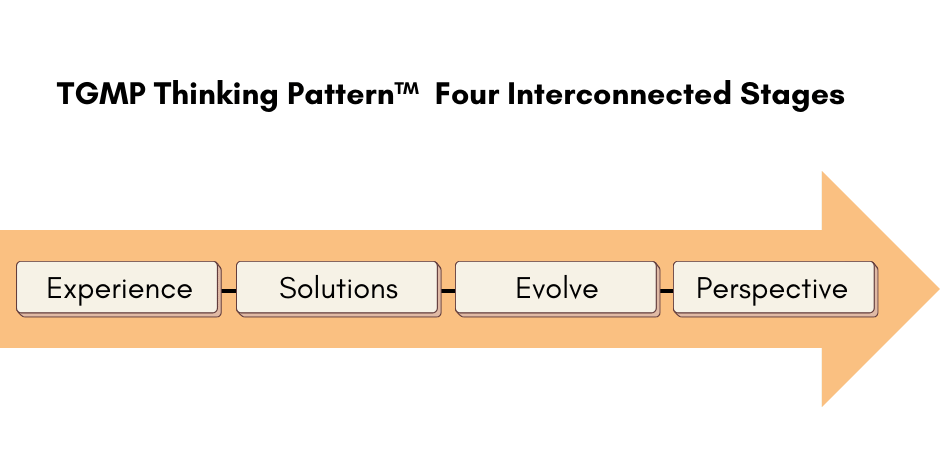
Think of the TGMP pattern as a feedback loop: Experience and data inform your Solutions; you Evolve your solution as you implement; finally you gain Perspective, which in turn becomes new Experience for the future. Skipping any stage can leave a blind spot ; for example, jumping from a problem straight to action (omitting Perspective) might solve the immediate issue but create long-term troubles, whereas endlessly reflecting without acting (omitting Evolve) means no decision actually moves forward. Each stage complements the others. Used in combination, they produce decisions that are both thorough and agile.
(Visualizing the Pattern: You can picture the TGMP framework as a circle or loop with four segments labeled Experience, Solutions, Evolve, and Perspective, each leading to the next, and an arrow from Perspective curving back to Experience to indicate continuous learning. Such a diagram underscores that decision-making is not a straight line with a hard stop; it’s a cycle where today’s “Perspective” feeds tomorrow’s “Experience.”)
Checkpoint Summary
Exercise - Identify Your Thinking Pattern: Every individual has a natural entry point in this cycle.
Let’s discover yours :
Recall a recent decision you made (big or small). What was the very first thought that crossed your mind? Did you instinctively zoom out to consider the big picture of the situation (Perspective)? Did you recall a past example or data point that could guide you (Experience)? Did you start mentally listing possible solutions to fix it (Solutions)? Or did you immediately think of a novel, creative approach unlike anything done before (Evolve, in the sense of innovation)?
Your first inclination reveals your preferred tool – the stage you naturally gravitate toward first. Now that you know, practice strengthening the other stages. For your next important decision, intentionally walk through all four steps in a sequence that feels right for you. If you started with your usual stage, challenge yourself to then proceed through the others one by one. If you tend to skip a stage (for example, rushing to act without reflecting, or vice versa), make a point of including it.
By doing this, you’re building a disciplined habit of comprehensive thinking without giving up your personal style . You’ll likely find that this awareness not only leads to better outcomes but also teaches you about your own decision-making strengths and blind spots.
You’ve got this – the path to becoming a confident, decisive leader isn’t about having all the answers; it’s about having a process to find them .