

Introduction: Turning Pressure into Purpose
Stepping into your first leadership role is exhilarating but also nerve-wracking. New managers commonly face imposter syndrome; the fear that they’re not truly qualified to make the tough calls. The framework is about building confidence and clarity as a first time manager.
Every day as a leader presents a new test. Imagine you’re managing a high-stakes project that’s veering off track while the deadline looms, your team looks to you for direction, and the pressure is on. In moments like this, how you decide is as crucial as what you decide. Seasoned leaders often instinctively cycle through a series of thought steps: recalling past experiences, brainstorming possible solutions, making real-time adjustments, and considering long-term consequences before committing . This pattern of thinking wasn’t always given a name, but here we articulate it as the TGMP Thinking Pattern™; a four-stage decision-making framework of Experience → Solutions → Evolve → Perspective . Developed in the trenches of leadership, TGMP blends intuition with analysis to provide clarity and confidence whether you’re a first-time manager or a seasoned executive making tough calls under uncertainty.
In this module, we will explore the TGMP framework in depth and learn how to apply it to real-world leadership challenges. We’ll see how its flexibility allows you to start at different entry points yet cover all critical angles of a decision. We’ll also briefly compare TGMP with other renowned models (like DARE, OODA, DECIDE, Vroom-Yetton-Jago) to underscore its completeness and unique advantages.
By the end of this module, you will be able to recognize your natural starting point (e.g big-picture vs action first) while ensuring all stages are addressed for a balanced decisions. You will also appreciate how the four components of TGMP Thinking Pattern interconnects as a decision-making cycle and its unique strength.
The TGMP Thinking Pattern™ Framework: Four Interconnected Stages
The TGMP decision-making framework consists of four interconnected stages: Experience, Solutions, Evolve, and Perspective . Think of these as four versatile tools or lenses that, when used together, form a powerful pattern of thinking. Just as individual letters combine to form words and sentences, these four elements link together to guide you through any decision . Each stage has a distinct purpose:
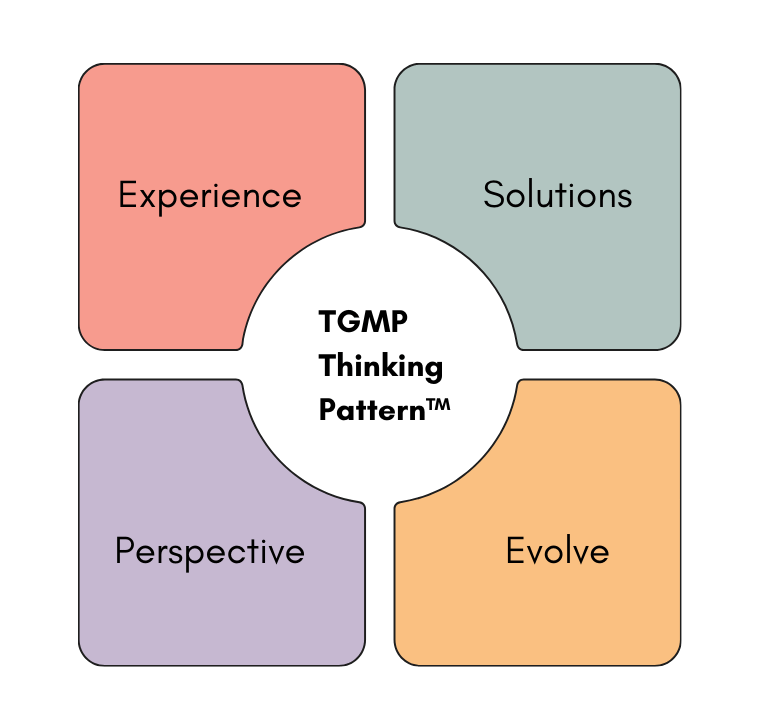
Experience – learning from the past and understanding the present context.
Solutions – generating options and plans to address the problem.
Evolve – adapting and iterating as you implement the solution.
Perspective – stepping back to see the big picture and long-term implications.
Importantly, these stages are interdependent. One flows naturally into the next, and together they create a full-cycle thought process. Let’s examine each stage in detail:
Stage 1: Experience – Leverage Past Experience to Define the Problem
Experience is about starting with what you already know. At this stage, you tap into prior experiences, knowledge, and situational awareness to ground the decision in reality . Ask yourself questions like: “Have I encountered a similar situation before? What patterns or lessons from the past apply here?” By recalling relevant examples or data, you gather information and context. In essence, you use your experience to define the problem and get a concrete grip on the situation . This might involve identifying key factors, constraints, or success parameters based on what you’ve seen work (or fail) previously.
Real-World Example: Imagine you’re facing a budget overrun in a project. In the Experience stage, you might recall a past project with a similar issue – perhaps recognizing that a late scope change was the culprit last time. You dig into that memory (and any documented lessons learned) to pinpoint if a similar scope creep is happening now. By doing so, you clarify what problem you truly need to solve (e.g. uncontrolled scope, resource shortfall, etc.), grounded by real past insights. This ensures you’re not jumping to conclusions without understanding context.
Reflection – Experience: Think of a recent challenge you faced. Did you pause to consider whether you’d seen something like it before? How did recalling (or failing to recall) a past experience influence how you understood the problem? Identifying analogous past situations can sharpen your situational awareness and help define the current problem more clearly .
Stage 2: Solutions – Brainstorm and Develop Options
Once the problem is defined, move to Solutions. This stage is about creative problem-solving and analysis; generating a range of potential solutions or plans and then honing in on the best approach . Leverage the data and facts at hand (including insights from the Experience stage) to ask “How can we address this?”. If Experience defined the “what” of the problem, Solutions explores the “how” . Here you brainstorm possible courses of action, consider different angles, and weigh pros and cons of each option. The goal is to develop one or more viable plans that fit the situation.
Real-World Example: Continuing the project budget scenario: in the Solutions phase you list possible ways to get the budget under control. For instance: (1) Reallocate funds from a non-critical part of the project, (2) Reduce scope or find efficiencies to cut costs, (3) Negotiate additional budget from stakeholders, or (4) Delay certain components to a later phase. You use data (like cost-benefit analysis of each option) and creative thinking to expand the list, then evaluate which option (or combination) might solve the issue with minimal downsides.
Reflection – Solutions: When you face a problem, do you tend to settle on the first solution that comes to mind, or do you deliberately brainstorm multiple options? Challenge yourself next time to list at least two distinctly different approaches. What new solution might emerge if you push yourself to consider an alternative? By widening your solution set, you increase the chances of finding an effective and innovative answer .
Stage 3: Evolve – Implement, Adapt, and Iterate
Having chosen a solution, you then implement it but the key in the Evolve stage is to stay adaptive. As the saying goes, “no plan survives reality unchanged.” Once a solution is in motion, be prepared to adjust, improvise, and iterate in response to real-world feedback . In the Evolve phase, you monitor the outcomes closely and make changes to improve effectiveness on the fly . Decision-making is rarely one-and-done; conditions can change, or initial assumptions might prove wrong. A great leader remains flexible after the initial decision, refining the tactics as needed to better meet the objective . This stage reminds us that executing a decision requires learning and tweaking it’s an ongoing process of evolution. Mike Tyson famously said; “Everyone has a plan until they get punched in the face”.
Real-World Example: After choosing a solution to the budget problem (say, reallocating funds and trimming low-value features), you implement those changes. In the Evolve stage, you keep a close eye on the project’s progress. Perhaps you discover that reallocating funds from another team is causing delays in that team’s work; a side effect you hadn’t anticipated. You then pivot: maybe you decide to partially restore that team’s funds and instead negotiate a small budget increase with the client. In doing so, you’re improvising and iterating on the plan to address issues as they arise. Leaders excelling in Evolve are not stubborn about the original plan; they adjust course to keep the solution effective.
Reflection – Evolve: Recall a time when a plan you executed didn’t go perfectly. How quickly did you notice and respond to problems or changes in conditions? Embracing the Evolve mindset means asking, “What am I learning as we implement, and how can we improve this solution in real time?”. By normalizing adaptation, you avoid the trap of sticking with a failing plan. Instead, you treat each decision as a learning process, which ultimately leads to better results and more agile teams. There is nothing constant except change.
Stage 4: Perspective – Step Back and Reflect on the Big Picture
Finally, Perspective is about taking a step back to look at the outcome and its broader implications. This is the stage of reflection and strategic, big-picture thinking . You ask yourself questions like: “If we pursue (or continue) this solution, what are the longer-term implications? Does this decision align with our overarching goals and values? What does success look like now, and is it sustainable later?”. In the Perspective phase, you evaluate the decision’s impact in both the short term and long term, ensuring that immediate actions connect to broader objectives . Crucially, Perspective also means capturing lessons learned. By reflecting on what the decision achieved and what you and your team learned, you feed valuable insights back into your reservoir of Experience, which will inform your future decisions . In this way, Perspective “closes the loop,” turning the outcome of one decision into guidance for the next.
Real-World Example: After stabilizing the project budget and finishing the project, you take time for Perspective. You review the outcome: the project was delivered on the revised budget and the team is satisfied, but one feature was cut. You ask, “Was cutting that feature the right long-term move? Did it affect customer satisfaction or our product vision?”. You also consider the team’s morale and stakeholder trust. Perhaps you realize that while the immediate crisis was solved, better upfront risk assessment could have prevented the scramble. The lesson learned might be to institute an earlier budget checkpoint in future projects. By reflecting in this way, you see beyond the firefighting of the moment to the strategic adjustments needed for the future. The decision’s immediate success is weighed against long-term goals, and new experience such as the value of early risk checks is added to your toolkit for next time.
Reflection – Perspective: Think about a decision you made recently, was there a formal moment of reflection afterward? If not, consider what insights you might have missed. Ask yourself, “In hindsight, what went well, what didn’t, and what does that mean for our long-term goals?”. By taking Perspective, you ensure each decision you make today contributes to wiser decisions tomorrow .